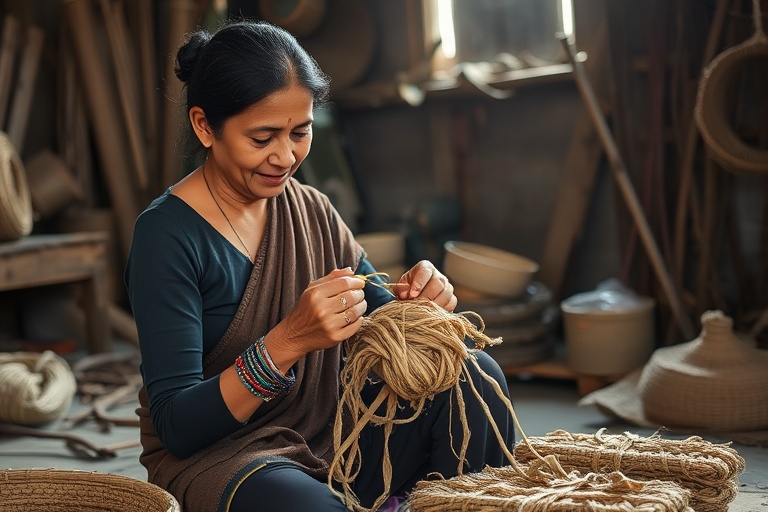
In the heart of rural Bangladesh, where the art of jute weaving has been passed down through generations, Fatima Rahman stands out as a true master of her craft. At 53, she has spent over four decades perfecting the intricate techniques that transform raw jute fibers into the stunning hammocks that have become Ecofy's signature products.
What makes Fatima's story remarkable isn't just her exceptional skill—it's how she has revolutionized traditional techniques while honoring her cultural heritage, becoming a leader in her community and an inspiration to artisans worldwide.
Early Life & Heritage
Born in a small village near Jamalpur, a region known for its jute production, Fatima began learning weaving techniques at just nine years old. Her grandmother, a respected weaver in the community, recognized Fatima's natural dexterity and patience—qualities essential for the demanding work of hammock creation.
"My earliest memories are of sitting beside my grandmother as she worked," Fatima recalls. "She would tell me stories of how jute had sustained our family for generations, even during the most difficult times."
By the age of 16, Fatima had already developed her own signature weaving style, incorporating subtle variations in traditional patterns that would later become her trademark. However, her journey was not without obstacles. As a young woman in a conservative rural area, her ambitions to expand her craft beyond traditional expectations faced resistance.
Innovative Techniques
What truly distinguishes Fatima's work is her innovative approach to traditional methods. While respecting ancestral techniques, she has introduced several modifications that have significantly improved both the durability and comfort of her hammocks.
Her most significant innovation came in 2010, when she developed a unique "double-twist" knotting method that increases a hammock's weight capacity by nearly 40% without adding bulk or sacrificing the signature flexibility that makes jute hammocks so comfortable.
The Double-Twist Method
This technique involves:
- A preliminary soaking process that increases fiber flexibility
- A specialized two-stage twisting pattern that creates stronger structural integrity
- A finishing technique that prevents fraying while maintaining softness
Fatima has also pioneered sustainable dyeing techniques using local plants and minerals, creating the subtle earth tones that have become a hallmark of Ecofy's aesthetic while eliminating the need for chemical dyes.
Overcoming Challenges
The path to mastery has not been without significant challenges. In the early 2000s, synthetic materials threatened to replace natural fibers in the global market, putting traditional jute crafts at risk. Many artisans in Fatima's village abandoned their looms for factory work.
"It was a dark time for our craft," Fatima explains. "Young people weren't interested in learning these skills anymore. They saw no future in it."
Rather than surrender to this trend, Fatima became determined to prove the enduring value of jute craftsmanship. She began experimenting with new designs that combined traditional techniques with contemporary aesthetics, creating pieces that appealed to international markets while maintaining authentic craftsmanship.
Community Impact
Perhaps Fatima's greatest achievement has been her impact on her community. In 2012, she established a training program for women in her village, teaching not only weaving techniques but also business skills. Today, this program has evolved into a cooperative that employs over 30 women, many of whom are the primary income earners for their families.
The economic impact has been transformative. Families that once struggled to meet basic needs now have stable incomes, and many have been able to send their children to school and improve their housing conditions.
Beyond the economic benefits, the cooperative has become a powerful force for women's empowerment in the region. Members have gained financial independence and decision-making authority within their households and community.
"Before joining Fatima's cooperative, I had never earned my own money or made decisions about my family's future. Now I am respected for my skills, and my daughter sees that women can be leaders and creators." — Nasreen, cooperative member since 2015
Sustainable Practices
Sustainability is at the core of Fatima's philosophy. Her approach includes:
Zero-Waste Production
Every scrap of jute is utilized—larger pieces for hammocks and bags, medium scraps for smaller accessories, and the smallest remnants are composted to fertilize the community garden where they grow plants for natural dyes.
Natural Dye Innovation
Fatima has documented over 20 natural dyeing recipes using local plants, fruits, and minerals. These techniques not only eliminate chemical pollution but also create distinctive colors that synthetic dyes cannot replicate.
Water Conservation
Traditional jute processing requires significant water usage. Fatima has developed a closed-loop water system that reduces consumption by 70% compared to conventional methods.
Looking to the Future
At 53, Fatima is now focused on ensuring her knowledge and innovations live beyond her. She has begun documenting her techniques in a comprehensive guide and is working with digital artisans to create video tutorials that will preserve these methods for future generations.
"My dream is that 100 years from now, someone will still be creating beautiful things with jute using techniques that came from our village," she says. "That would mean our work today truly mattered."
Her partnership with Ecofy has been instrumental in this vision, creating a sustainable market for traditional crafts while introducing these authentic pieces to homes across Europe and beyond.
As we conclude our visit, Fatima shows us a hammock she is currently working on—a special commission featuring an intricate pattern inspired by traditional Bengali textiles. Her hands move with practiced precision, each knot and twist executed with perfect tension. It's a mesmerizing demonstration of skill honed over decades.
"This is not just a hammock," she tells us with quiet pride. "It's a piece of Bangladesh, a piece of history, and a piece of my heart."
And that, perhaps, is the true magic of Fatima's work—each piece carries not just exceptional craftsmanship, but a living connection to culture, community, and the skilled hands that created it.